
Turf management in the United States has evolved far beyond the simple act of mowing and watering . From the high-stakes environments of Major League Baseball diamonds to the pristine fairways of Augusta National, the lush, resilient green we see is the product of rigorous chemical engineering . To the untrained eye, it is just grass; to the specialist, it is a complex biological system governed by the laws of thermodynamics, molecular biology, and soil chemistry . Mastering this field requires a profound understanding of how elemental interactions at the microscopic level manifest as durability and aesthetic perfection at the macroscopic level.
In the competitive US agricultural sector, professionals must navigate the intricate balance of nitrogen, phosphorus, and potassium (NPK) ratios while managing soil salinity and microbial health . For many students entering this specialized field, the academic barrier to entry is high . Navigating these complexities often requires looking at real-world data; for instance, high-achieving scholars often utilize comprehensive case study help in the USA to decode how top-tier stadiums maintain soil health under extreme weather stress . This bridge between theory and practice is what defines an expert in the field.
However, the foundation of turf management is undeniably rooted in pure chemistry . Aspiring turf managers in the United States must master redox reactions, cation exchange capacity (CEC), and the specific chemical pathways of photosynthesis . Given the heavy workload, it isn’t uncommon for vocational students to seek out a professional who can take my chemistry exam for me so they can focus on the hands-on application of these scientific principles in the field . Without this deep chemical knowledge, the risk of soil toxicity or nutrient lockout becomes an inevitable reality .
Key Takeaways
- Soil pH is the Gatekeeper: Most turfgrasses thrive in a pH range of 6.0 to 7.0, where nutrient availability is maximized .
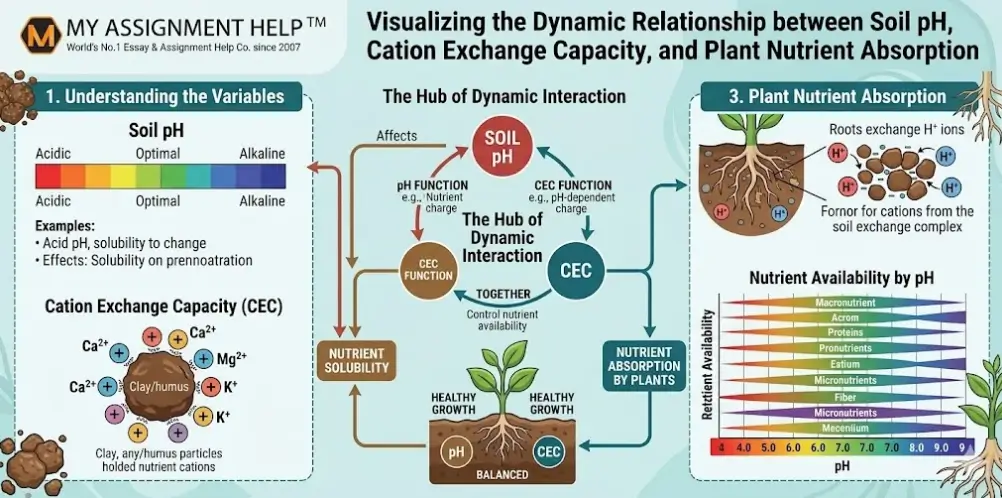
- Cation Exchange Capacity (CEC): This measures the soil’s ability to hold onto essential nutrients like Calcium and Magnesium .
- The Nitrogen Cycle: Understanding volatilization and leaching is critical to reducing environmental impact and costs .
- Micronutrient Precision: Elements like Iron (Fe) and Manganese (Mn) are essential for the deep “emerald green” color sought in professional sports .
The Chemistry of Soil pH and Nutrient Bioavailability
In the United States, soil types vary drastically—from the acidic clays of the Southeast to the alkaline sands of the Southwest . Chemistry experts focus primarily on pH because it dictates whether nutrients are “locked” or “unlocked” for the plant . When soil pH drops below 5.5, aluminum toxicity can become a significant threat, stunting root growth . Conversely, when pH exceeds 7.5, essential micronutrients like Iron become chemically unavailable to the grass, leading to chlorosis (yellowing).
Cation Exchange Capacity (CEC): The Soil’s Battery
One of the most technical aspects of turf management is managing the CEC . Think of the soil as a battery; the CEC represents its capacity to hold a “charge” of nutrients . Clay soils and organic matter have high negative charges, allowing them to attract and hold positively charged ions (cations) like Potassium (K^+) and Calcium (Ca^{2+}) .
In many US golf course constructions, sandy “USGA spec” greens are used for drainage . However, sand has a very low CEC, meaning chemistry experts must use “spoon-feeding” techniques—applying small amounts of liquid fertilizers frequently—to prevent nutrient leaching into the groundwater .
| Metric | Industry Standard (USA) | Strategic Relevance |
| Soil Testing Frequency | 70% of US golf courses test at least twice a year | Monitors shifting nutrient profiles |
| Annual Sector Spend | ~1.5 Billion spent on turf chemicals annually | Highlights economic scale of chemical precision |
| Optimal pH Target | 6.5 pH (The “Golden Ratio”) | Maximizes bioavailability of NPK and micronutrients |
Advanced Biochemistry: Managing Abiotic Stress
Modern US turf management now incorporates the use of biostimulants—substances like humic acid and seaweed extracts . These aren’t fertilizers in the traditional sense; they are chemical catalysts that improve the plant’s metabolic efficiency . By stimulating the production of antioxidants within the grass blades, chemistry experts help turf survive the blistering summer heat of the Midwest or the freezing winters of New England . This level of precision requires a mastery of plant physiology that goes far beyond basic gardening .
See also: How to Build a Strong Brand Identity
The Environmental Impact of Chemical Management
With increasing regulations across the US, the modern turf manager is also a steward of the environment . Over-application of phosphorus can lead to eutrophication in local waterways . Therefore, experts use slow-release nitrogen polymers and nitrification inhibitors—chemical compounds that slow the conversion of ammonium to nitrate—ensuring that the grass absorbs the nutrients before they can wash away .
Frequently Asked Questions (FAQ)
How often should I test the soil in a professional turf setting?
In the USA, professional standards suggest testing at least twice a year (spring and fall) to monitor nutrient levels and adjust chemical applications based on seasonal needs .
Why does my grass look yellow even after applying nitrogen?
This is often a result of “nutrient lockout” due to high soil pH . If the pH is too high, the grass cannot absorb Iron, regardless of how much nitrogen is applied . A chemical soil test is required to confirm the exact levels .
What is the most important chemical for green color?
While Nitrogen is the primary driver of growth, Iron (Fe) is the chemical key to a deep green color without causing excessive vertical growth .
About the Author:
This article was authored by a lead research specialist at MyAssignmentHelp . With a background in agricultural science and technical writing, the author helps students across the USA master the complexities of environmental chemistry and professional land management .
References & Sources:
- University of Florida IFAS Extension: “Soil Testing and Interpretation for Florida Turfgrasses” (2024) .
- Penn State Center for Turfgrass Science: “The Role of Soil pH in Turfgrass Management” (2025) .
- USGA Green Section Record: “Managing Cation Exchange in Sand-Based Rootzones” .
- American Chemical Society (ACS): “Biochemical Pathways of Turfgrass Stress Tolerance” .


 By
By